
Benjamin Vautier, known as Ben (1935–2024)
Introduction.
This tribute is not mimetic, but faithful to his spirit: saying little to say the truth and letting the idea do the work.
On the French Riviera, Ben is everywhere without ever being intrusive.
Museums, public collections, galleries, cities, tram stops, but also in the collective memory and even in the office of the President of the National Council of Monaco.
His use of words as art, his black and white as a space of truth, and his economy of means—which never impoverish the message but, on the contrary, make it more demanding and authentic—make his approach a strong, almost organic contemporary conceptual imprint, eager to awaken rather than seduce, while maintaining a deep attachment to reality and simplicity.
Benjamin Vautier was born on July 18, 1935, in Naples, to a Swiss father from French-speaking Switzerland and an Irish and Occitan mother.
The great-grandson of painter Marc Louis Benjamin Vautier, he grew up in several countries—Switzerland, Turkey, Egypt, Italy—before settling in Nice in 1949.
His youth, spent traveling between languages and territories, nurtured a keen awareness of cultural identities, which would become a central theme in his thinking.
Self-taught, he did not pursue any formal training in art; his learning came through observation, reading, debate, and experimentation.
At the end of the 1950s, he opened a second-hand record store in Nice, on Rue Tonduti de l’Escarène.
The place quickly became more than just a commercial space.
Artists, poets, and thinkers would meet there.
The storefront was filled with objects, and the interior became a place for exhibitions and discussions.
This “Magasin” became one of the hubs of what would come to be known as the School of Nice, alongside artists such as César, Arman, Martial Raysse, and Yves Klein.
From this period onwards, Ben understood that art was not limited to the object produced: it also resided in the attitude adopted.
In the early 1960s, he joined the Fluxus movement after meeting George Maciunas in London in 1962.
He adopted an original stance: shifting art from the realm of fabrication to that of intention.
He then developed several fundamental themes.
Appropriation,
The signature as a founding act,
The declaration as a work of art,
The blurring of the boundary between art and life.
He asserted that anything can become art as long as an artist declares it to be so; this position underpinned all of his work.
He created performances and “gestures,” signed objects, places, and actions, organized festivals in Nice, and participated in Documenta 5 in Kassel in 1972.
His interventions, sometimes provocative, questioned legitimacy, authority, and the very definition of the work of art.
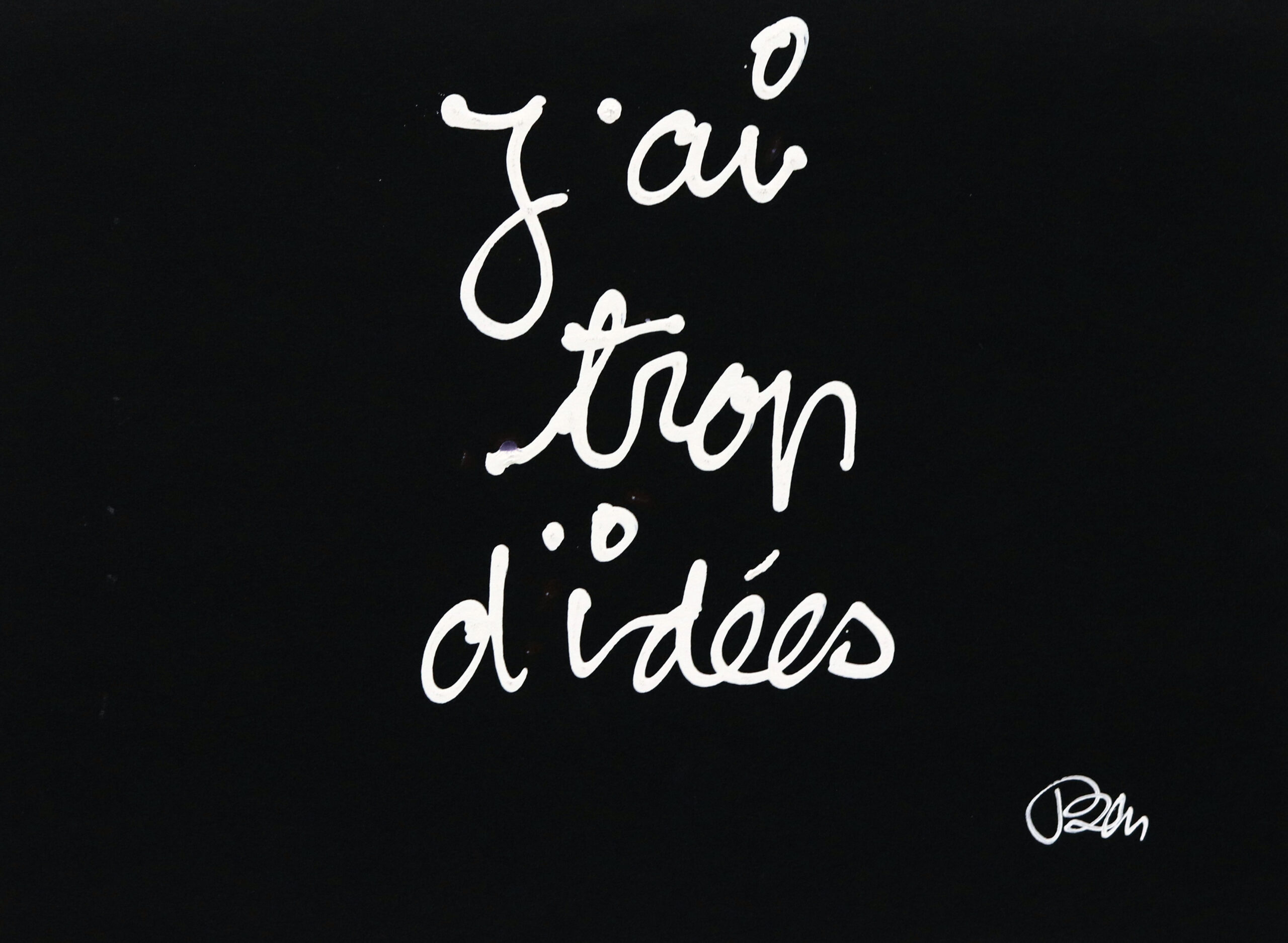
Handwritten sentences, direct and unadorned, address the ego, novelty, doubt, money, death, and truth.
The word does not comment on the work: it is the work.
This practice contributes to broadening the scope of conceptual art in Europe.
It ensures its international recognition and wider dissemination, including outside museum settings.
His work is featured in many major collections around the world.
These include the Centre Pompidou (Paris), MoMA (New York), Stedelijk Museum (Amsterdam), Museum Moderner Kunst (Vienna), and MAMAC (Nice), among others.
He was named Chevalier, then promoted to Officier de l’Ordre des Arts et des Lettres.
This distinction is official recognition of a career forged in constant—and sometimes critical—dialogue with institutions.
Legacy.
Ben Vautier occupies a unique place in European contemporary art: he did not seek a style, but established a position and made attitude his principle.
Introduction.
This tribute is not mimetic, but faithful to his spirit: saying little to say the truth and letting the idea do the work.
On the French Riviera, Ben is everywhere without ever being intrusive.
Museums, public collections, galleries, cities, tram stops, but also in the collective memory and even in the office of the President of the National Council of Monaco.
His use of words as art, his black and white as a space of truth, and his economy of means—which never impoverish the message but, on the contrary, make it more demanding and authentic—make his approach a strong, almost organic contemporary conceptual imprint, eager to awaken rather than seduce, while remaining attached to reality.
Origins
Benjamin Vautier was born on July 18, 1935, in Naples, to a Swiss father from French-speaking Switzerland and an Irish and Occitan mother.
The great-grandson of painter Marc Louis Benjamin Vautier, he grew up in several countries—Switzerland, Turkey, Egypt, Italy—before settling in Nice in 1949.
His youth, spent traveling between languages and territories, nurtured a keen awareness of cultural identities, which would become a central theme in his thinking.
Self-taught, he did not pursue any formal training in art; his learning came through observation, reading, debate, and experimentation.
The Store
At the end of the 1950s, he opened a second-hand record store in Nice, on Rue Tonduti de l’Escarène.
The place quickly became more than just a commercial space.
Artists, poets, and thinkers would meet there.
The storefront was filled with objects, and the interior became a place for exhibitions and discussions.
This “Magasin” became one of the hubs of what would come to be known as the School of Nice, alongside artists such as César, Arman, Martial Raysse, and Yves Klein.
From this period onwards, Ben understood that art was not limited to the object produced: it also resided in the attitude adopted.
Fluxus
In the early 1960s, he joined the Fluxus movement after meeting George Maciunas in London in 1962.
He adopted an original stance: shifting art from the realm of fabrication to that of intention.
He then developed several fundamental themes.
Appropriation,
The signature as a founding act,
The declaration as a work of art,
The blurring of the boundary between art and life.
He asserted that anything can become art as long as an artist declares it to be so.
Performances, gestures, and actions
He created performances and “gestures,” signed objects, places, and actions, organized festivals in Nice, and participated in Documenta 5 in Kassel in 1972.
His interventions, sometimes provocative, questioned legitimacy, authority, and the very definition of art.
The writings
Handwritten sentences, direct and unadorned, address the ego, novelty, doubt, money, death, and truth.
The word does not comment on the work: it is the work.
This practice contributes to broadening the scope of conceptual art in Europe.
It ensures its international recognition and wider dissemination, including outside museum settings.
Institutional recognition
His work is featured in many major collections around the world.
Centre Pompidou (Paris), MoMA (New York), Stedelijk Museum (Amsterdam), Museum Moderner Kunst (Vienna), MAMAC (Nice).
He was named Chevalier, then promoted to Officier de l’Ordre des Arts et des Lettres.
This distinction recognizes a career forged in constant—and sometimes critical—dialogue with institutions.
Legacy.
Ben Vautier occupies a unique place in European contemporary art: he did not seek a style, but established a position and made attitude his principle.
Ben's world
Introduction.
This tribute is not mimetic, but faithful to his spirit: saying little to say the truth and letting the idea do the work.
On the French Riviera, Ben is everywhere without ever being intrusive.
Museums, public collections, galleries, cities, tram stops, but also in the collective memory and even in the office of the President of the National Council of Monaco.
His use of words as art, his black and white as a space of truth, and his economy of means—which never impoverish the message but, on the contrary, make it more demanding and authentic—give his approach a strong, almost organic contemporary conceptual imprint, eager to awaken rather than seduce, while maintaining a deep attachment to reality, simplicity, and intuition.
Origins
Benjamin Vautier was born on July 18, 1935, in Naples, to a Swiss father from French-speaking Switzerland and an Irish and Occitan mother.
The great-grandson of painter Marc Louis Benjamin Vautier, he grew up in several countries—Switzerland, Turkey, Egypt, Italy—before settling in Nice in 1949.
His youth, spent traveling between languages and territories, nurtured a keen awareness of cultural identities, which would become a central theme in his thinking.
Self-taught, he did not pursue formal training in art; his learning was built on observation, reading, debate, and experimentation.
The Store
At the end of the 1950s, he opened a second-hand record store in Nice, on Rue Tonduti de l’Escarène; the place quickly outgrew its commercial function.
Artists, poets, and thinkers would meet there.
The façade opened up to an accumulation of objects, and the interior became a venue for exhibitions and free, daily discussion.
This “Magasin” was one of the hubs of what would become known as the School of Nice, alongside artists such as César, Arman, Martial Raysse, and Yves Klein.
From this period onwards, Ben understood that art was not limited to the object produced: it also resided in the attitude adopted.
Fluxus
In the early 1960s, he joined the Fluxus movement after meeting George Maciunas in London in 1962.
He adopted an original stance: shifting art from the realm of fabrication to that of intention, and then developed several themes.
Appropriation,
The signature as a founding act,
The declaration as a work of art,
The blurring of the boundary between art and life.
He asserted that anything can become art as long as an artist declares it to be so; this position underpins all of his work.
Performances and actions
He created performances and “gestures,” signed objects, places, and actions, organized festivals in Nice, and participated in Documenta 5 in Kassel in 1972.
His interventions, sometimes provocative, questioned legitimacy, authority, and the very definition of art.
The writings
Handwritten sentences, direct and unadorned, address the ego, novelty, doubt, money, death, and truth; the words do not comment on the work, they are the work.
This practice contributes to broadening the scope of conceptual art in Europe.
It ensures its international recognition and wider dissemination, including outside museums.
Institutional recognition
His work is featured in numerous major collections around the world.
Centre Pompidou (Paris), MoMA (New York), Stedelijk Museum (Amsterdam), Museum Moderner Kunst (Vienna), MAMAC (Nice).
Appointed Chevalier, then promoted to Officier de l’Ordre des Arts et des Lettres, he has received official recognition for a career forged in constant—and sometimes critical—dialogue with institutions.
Legacy.
Ben Vautier occupies a unique place in European contemporary art: he did not seek a style, but established a position and made attitude his principle.